
Get on the list
The deck is not printed yet. Leave your email and you will hear first, before anyone else.
Questions
Rules
How do you play SK8COMBO, in short?
Everyone builds a face-down row of 5 cards and tries to make the highest-scoring trick layout out of it. The game runs in five phases: from 3 cards in hand you pick one “anchor” card and place it face down, you are dealt four more sight unseen, and then you take turns drawing, swapping and sabotaging your rivals until someone calls “Drop in”. Then everyone flips their cards and counts.
Which tricks are in the game and what are they worth?
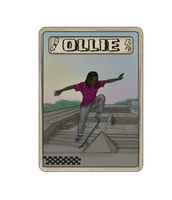
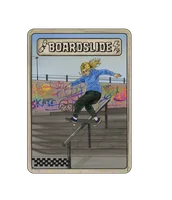
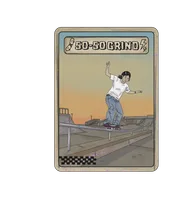
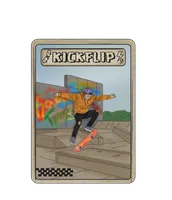
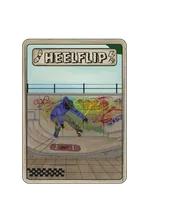
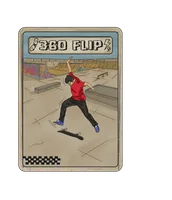
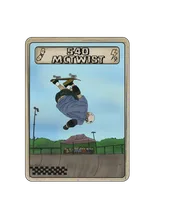
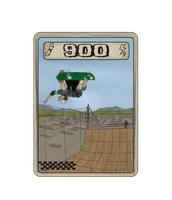
Eight, five copies of each, ordered by real-world difficulty: ollie (1), boardslide (2), 50-50 grind (3), kickflip (4), heelflip (5), 360 flip (6), 540 McTwist (7) and 900 (8). A card is worth its place on that ladder.
How is scoring done and what are the combos?
You add up the values of your five tricks and add the layout bonus: pair +5, small straight (three cards in a row) +10, three of a kind +15, full house +30, four of a kind +40, big straight (five cards in a row) +50. Everyone records their own score, and the rounds add up until someone reaches the target for the mode you picked.
Can I score more than one combo at a time?
Yes, combos stack. Say you hold 1-2-3-5-5: that is a small straight and a pair, +10 and +5, so +15 of bonus. One rule governs it - each card counts toward one combo only. If the ollie is doing work in the straight, that same ollie cannot also make a pair. One exception: a three of a kind and a pair sitting together are a full house for +30, not +15 and +5 separately.
Is there a bonus for a four-card run?
No. Only three in a row (small straight, +10) and five in a row (large straight, +50) pay. A run of 1-2-3-4 therefore scores as a small straight, +10 - the fourth card adds nothing.
Is five of a kind a combo?
No. The highest combo built on repeats is four of a kind, +40. A fifth card of the same trick does not raise the bonus, it only adds its own point value.
Does the order of cards in my row matter?
No. The physical arrangement on the table is irrelevant. A straight can sit there as 4, 2, 5, 1, 3 and it is still a straight. Only the card values count: at the reveal you simply group them into layouts and add up the points.
Is my first card locked or not?
Its slot is locked, the card in it is not. The anchor sits in the spot you chose and you may neither move it nor look at it. What can change is what is in that spot: on your turn you can trade it for a card you draw, and a rival can swap it away. The replacement goes into exactly the same slot.
Can I rearrange the cards in my row?
No. The slots are locked. You may not move a card from the edge into the middle. When you swap a card during play, the new one goes into exactly the slot you took the old one from.
Can I peek at my own face-down cards?
No, not even the first one you picked yourself. From the moment a card lands face down on the table, you only know it from memory. The only exceptions are discarding a card out of your row and playing a Spy Drone.
How many points is The G.O.A.T. worth?
It depends what you do with it. If it completes a layout, it takes the value of the missing card and counts as that specific trick, but then you do not get its base 15 points. If it forms no layout at all, it counts as a standalone card worth 15 points.
What if I have two G.O.A.T.s in one row?
You settle each one separately, and the call is yours both times. One can stand in for the card a combo is missing while the other keeps its own 15 points, or both can do the same thing. Take whichever way of splitting them scores you more.
What does Wipeout do if it stays in my row?
It kills the flow. The cards lying immediately to its left and right are worth 0 points and count toward no combo at all. If Wipeout ends up at the edge of the row (slot 1 or 5), it zeroes only one card.
What is an unused action card worth?
Zero. An unfired Spy Drone or Switch Up revealed in your row is simply an empty slot worth 0 points. The Wipeout is a trap card, it is worth 0 too, but on top of that it zeroes the cards beside it. The only exception is The G.O.A.T.
What happens if someone reveals a higher layout than mine?
You get outbid: every card of yours is worth 0 for that round and you take -10 points. A tie counts the same as a loss, and your rivals keep everything they earned. Call the drop and actually score the most, though, and your total for that round is doubled. That is why the moment you call “Drop in” matters more than the cards themselves.
What ends the round if nobody calls “Drop in”?
Nothing, and that is the point. The round lasts until somebody drops in, so you keep playing until one of you holds a combo good enough to be worth announcing. You will not run out of cards: when the deck is spent, the discard pile is shuffled and goes back into play.
Do I have to keep the card I drew?
No. If the trick or action you drew does not suit you, discard it straight away. Careful though: discarding a Switch Up or a Spy Drone fires its effect automatically, so you may use it if you want to.
Can I take a card from the discard pile?
Yes. Instead of drawing blind from the deck you may take the top card of the discard pile, but then everyone sees what you have. A special card taken this way can only be played on your next turn.
When can I use Wipeout?
Two ways. Sabotage works only in the last phase of the round, once somebody has called “Drop in!”: you play the Wipeout straight after drawing it, or take it out of your own row, slot it face down into a rival's row and discard their card. No Switch Up needed for that. The other option is to slot it blind into your own row and wait - then you play it later, but only together with a Switch Up. If you play a Wipeout out of your own row, draw a new card into its place first. The point is that both rows stay at five throughout: you patch the hole the Wipeout left, and your rival discards the card the Wipeout displaced.
What if the deck runs out?
You shuffle the discard pile and it becomes the new deck. Play continues without a break.
Who wins in case of a tie?
The player whose final round held the higher-value layout. If you both crossed the points threshold in the same round, the quality of that closing combo decides it, not the total.
Skate
Are the trick names in the game real?
All eight are real tricks, in the real order of difficulty, from the ollie everyone learns first to the 900, two and a half rotations in the air. A higher-value card is a trick you learn later.
Which skateboard trick should you learn first?
The ollie. Without it you cannot land any airborne trick, because every other one is a variation of it. Then boardslide and 50-50 grind, and only after that the kickflip. The cards in the game are ordered exactly that way.
What is the difference between a kickflip and a heelflip?
The direction the board spins and what you flick it with. A kickflip is flicked with your toes and the board rolls towards your heels; a heelflip is flicked with your heel and the board spins the other way. In the game a kickflip is worth 4 points and a heelflip 5, because it forgives fewer mistakes.
What is a 900 in skateboarding?
Two and a half rotations in the air above a ramp, or 900 degrees. A legendary trick, which is why it is the highest card in the deck.
About the game
How many people can play?
2 to 4 players. With two it is faster and nastier, with four there is more going on and it is harder to guess what your rivals will do.
What age is this game for? Will a 7-year-old understand the rules?
Ages 7 and up. The rules take five minutes to explain, and every player gets their own aid card with the scoring cheat sheet, so nobody has to memorise anything.
How long does one game take?
As long as you decide before the deal. A quick session to 200 points runs 15-20 minutes, Classic to 300 about 30 minutes, Pro Tournament to 500 about 45 minutes. A single round takes a few minutes, so you can stop the game at any point.
Do I need to know how to skate to play?
No. The trick names are real, but the game is about memory and card layouts, not board skills. It is played by kids who have skated for years and by kids who have never owned a board. After one game both know eight trick names.
Is this a good gift for a kid who skates?
Yes, and for a concrete reason: the tricks on the cards are real, ordered from the easiest (ollie) to the hardest (900), so a kid picks up the names and the hierarchy they will later see at the skatepark. The box fits in a backpack and a game lasts a quarter of an hour, so it works for a rainy day, for camp and for a trip.
Is this just a kids' game, or will adults get into it?
They will. The Pro Tournament mode to 500 points runs 45 minutes and is a game of bluff, memory and steady nerves. If you remember Tony Hawk landing the first 900 in 1999, the highest card in the deck is for you.
How many cards are in the box and what exactly do I get?
58 cards: 40 trick cards, 6 Switch Ups, 4 Spy Drones, 2 Wipeouts, 2 G.O.A.T.s and 4 aid cards with the scoring cheat sheet, one per player. Plus an illustrated rulebook.
What language is the game in?
SK8COMBO exists in two separate language versions, Polish and English. One box holds one version, and you pick it when you order.
When can I buy it?
We are pre-print. Leave your email. The people on the list hear first, before the game goes on sale.
How do you spell the name?
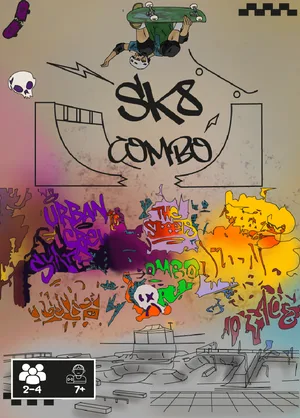
One word, with the eight: SK8COMBO. People write it every other way too, because the name hides three decisions at once: skate or sk8, combo or kombo, one word or two. Skatecombo, skate combo, skejtkombo, sk8 kombo - they all mean this game. The official spelling is SK8COMBO and the site is sk8combo.com.